
Introduction
Artificial Intelligence is becoming a part of everyday life. From virtual assistants like ChatGPT and Siri to self-driving cars, medical diagnosis systems, online shopping recommendations, and smart security cameras, AI is changing how people live and work. As this technology becomes more powerful, one important question continues to grow:
Is Artificial Intelligence Safe?
The answer isn’t simply “yes” or “no.” Artificial Intelligence offers incredible benefits, but like any powerful technology, it also comes with risks and challenges. When developed responsibly, AI can improve healthcare, education, transportation, business, and many other industries. However, if used without proper regulations or ethical guidelines, it can create concerns related to privacy, cybersecurity, misinformation, bias, and employment.
Understanding Is Artificial Intelligence Safe is becoming increasingly important for students, professionals, businesses, and everyday users. Millions of people interact with AI-powered systems every day without realizing how much these technologies influence their decisions, online experiences, and even personal data.
Some people worry that AI may eventually replace human jobs or make decisions without human control. Others believe Artificial Intelligence will solve some of the world’s biggest problems by improving scientific research, automating dangerous tasks, and increasing productivity. Both perspectives have valid points, making it essential to understand both the advantages and the risks of AI.
In this beginner-friendly guide, we’ll answer the question Is Artificial Intelligence Safe by exploring how AI works, its biggest benefits, potential dangers, real-world examples, safety measures, and what the future may look like. By the end of this article, you’ll have a balanced understanding of whether Artificial Intelligence is truly safe and how it can be developed responsibly.
If you’re new to AI, you may also want to read our detailed guide on What Is Artificial Intelligence? before exploring whether Is Artificial Intelligence Safe.
https://aitechaura.com/what-is-artificial-intelligence/
Why Do People Ask “Is Artificial Intelligence Safe?”
As Artificial Intelligence becomes more advanced, people naturally have questions about its safety. The question “Is Artificial Intelligence Safe” is becoming one of the most searched AI-related topics because AI is now involved in many parts of everyday life.
Today, Artificial Intelligence helps recommend videos on YouTube, detects online fraud, assists doctors in diagnosing diseases, powers customer support chatbots, and even helps businesses make important decisions. While these applications offer many benefits, they also raise concerns about privacy, security, fairness, and human control.
Many people worry that AI systems may make incorrect decisions, misuse personal information, or replace human workers. Others are concerned about cybercriminals using AI to create scams, fake images, or misleading information. These concerns have encouraged governments, technology companies, and researchers to focus more on responsible AI development.
Another reason people ask “Is Artificial Intelligence Safe” is that AI technology is evolving rapidly. Every year, AI becomes more powerful and capable of performing tasks that once required human intelligence. As these systems become more advanced, ensuring they remain safe, transparent, and ethical becomes increasingly important.
Although these concerns are understandable, it’s equally important to remember that Artificial Intelligence itself is not automatically dangerous. Like any technology, its impact depends on how it is designed, developed, and used.
Benefits of Artificial Intelligence
Before discussing the risks, it’s important to understand why Artificial Intelligence has become one of the world’s fastest-growing technologies. When used responsibly, AI provides enormous benefits across almost every industry.
1. Improves Healthcare
Artificial Intelligence helps doctors analyze medical images, detect diseases earlier, assist in drug development, and improve patient care. AI-powered systems can often process medical data much faster than humans, helping healthcare professionals make informed decisions.
2. Automates Repetitive Tasks
Businesses use AI to automate routine work such as data entry, customer support, inventory management, and document processing. This allows employees to focus on more valuable and creative tasks.
3. Enhances Online Security
Banks and financial institutions use AI to identify suspicious transactions and prevent fraud. Cybersecurity systems also rely on AI to detect unusual network activity and respond to potential threats more quickly.
4. Personalizes User Experience
Many popular online services use Artificial Intelligence to provide personalized recommendations. Streaming platforms suggest movies based on viewing history, while online stores recommend products according to customer preferences.
5. Supports Scientific Research
Researchers use AI to analyze massive datasets, discover patterns, and accelerate scientific breakthroughs in medicine, climate research, and space exploration.
These advantages explain why Artificial Intelligence continues to grow rapidly across the world. However, understanding Is Artificial Intelligence Safe also requires examining the potential risks associated with this powerful technology.
Artificial Intelligence is accelerating innovation across healthcare, climate science, and many other industries. You can explore more about AI technologies through IBM’s Artificial Intelligence Guide.
https://www.ibm.com/topics/artificial-intelligence
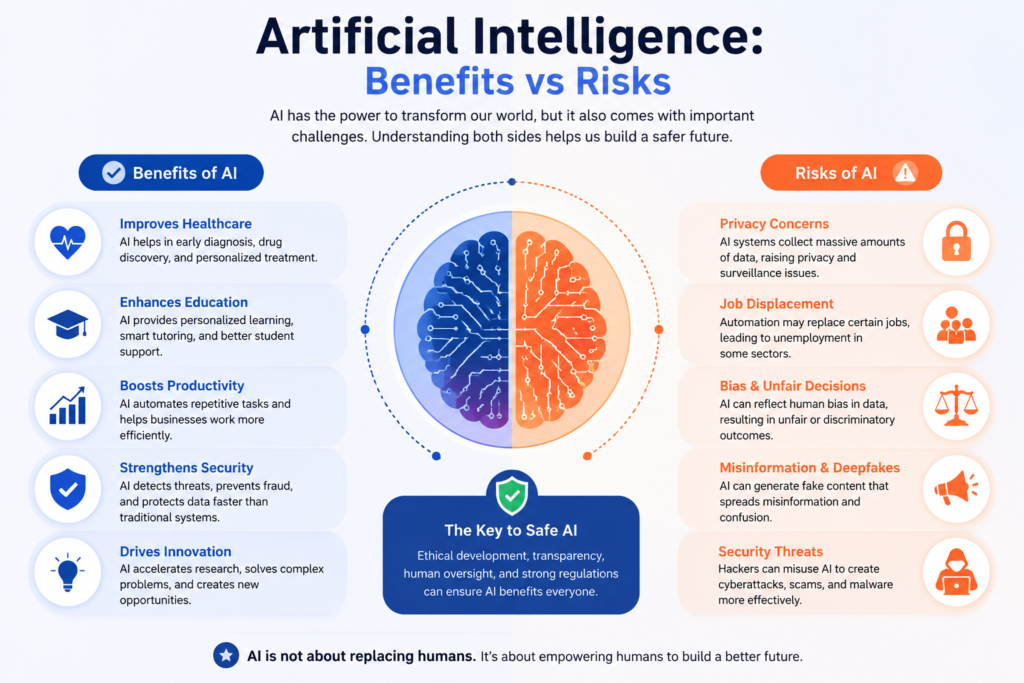
Risks of Artificial Intelligence: Is Artificial Intelligence Safe for Everyone?
Although Artificial Intelligence offers countless benefits, it also presents several challenges that cannot be ignored. When discussing Is Artificial Intelligence Safe, it’s important to understand that AI itself is neither good nor bad. The real concern lies in how people design, train, and use these intelligent systems.
Below are some of the biggest risks associated with Artificial Intelligence.
1. Privacy Concerns
Modern AI systems rely on large amounts of data to learn and improve. This data may include search history, shopping habits, location information, voice recordings, and even facial images.
If organizations fail to protect this information properly, personal privacy may be compromised.
For example, some AI-powered applications collect user behaviour to provide personalised recommendations. While this improves user experience, it also raises questions about how personal data is stored, shared, and protected.
2. AI Bias and Unfair Decisions
Artificial Intelligence learns from historical data. If that training data contains bias, the AI system may unintentionally produce unfair or inaccurate results.
For example:
- Hiring software may favour certain applicants.
- Loan approval systems may treat groups differently.
- Facial recognition may perform better for some populations than others.
This is why developers work hard to reduce bias and improve fairness when training AI models.
3. Job Displacement
Another reason people ask “Is Artificial Intelligence Safe” is because AI can automate many repetitive tasks that humans currently perform.
Industries such as manufacturing, customer support, transportation, and administration are increasingly using AI-powered automation.
While some traditional jobs may disappear, Artificial Intelligence is also creating entirely new careers in AI development, cybersecurity, robotics, data science, and machine learning.
Experts generally believe that AI will transform jobs rather than completely eliminate human workers.
4. Cybersecurity Threats
Artificial Intelligence can strengthen cybersecurity by detecting threats quickly, but criminals can also misuse AI.
Examples include:
- AI-generated phishing emails
- Deepfake videos
- Automated hacking attempts
- Identity theft
- Online scams
This is why governments and technology companies continue investing in AI security solutions.
5. Misinformation and Deepfakes
One of the fastest-growing concerns surrounding Artificial Intelligence is the rise of AI-generated fake content.
Modern AI can produce realistic:
- Images
- Videos
- Audio recordings
- News articles
Although these technologies have many legitimate uses, they can also spread misinformation if used irresponsibly.
As AI continues improving, learning how to identify trustworthy information will become increasingly important.
How Can Artificial Intelligence Be Made Safer?
Answering “Is Artificial Intelligence Safe” also means understanding the steps being taken to make AI more reliable and responsible.
Technology companies, researchers, and governments are working together to develop AI systems that are secure, transparent, and ethical.
Some of the most important safety measures include:
Ethical AI Development
Developers follow ethical guidelines that focus on fairness, transparency, accountability, and human oversight.
Better Data Protection
Organizations use encryption, privacy controls, and secure data management practices to protect user information.
Human Supervision
Many AI systems continue to require human review before making important decisions, especially in healthcare, finance, and legal services.
Government Regulations
Countries around the world are introducing AI regulations to encourage responsible development while protecting public safety and privacy.
Continuous Testing
AI models are regularly tested and updated to reduce errors, improve fairness, and identify potential security risks before deployment.
These safety practices help ensure that Artificial Intelligence continues benefiting society while minimizing potential risks.
Responsible AI development focuses on transparency, accountability, fairness, and human oversight. Learn more from IBM’s AI Ethics and Governance.
The Future of Artificial Intelligence: Is Artificial Intelligence Safe in the Long Term?
The future of Artificial Intelligence looks incredibly promising. Experts believe AI will continue transforming industries, improving productivity, and solving problems that are difficult for humans alone. However, as AI becomes more powerful, ensuring its safe and responsible development will become even more important.
When asking “Is Artificial Intelligence Safe”, the long-term answer depends on how governments, technology companies, researchers, and society work together to establish clear rules and ethical standards.
In the coming years, Artificial Intelligence is expected to play an even bigger role in:
- Healthcare and medical research
- Education and personalized learning
- Smart transportation
- Scientific discoveries
- Climate change solutions
- Agriculture
- Financial services
- Manufacturing automation
As these technologies continue advancing, AI safety will remain one of the highest priorities worldwide.
Many organizations, including OpenAI, Google, Microsoft, IBM, and governments around the world, are investing heavily in AI safety research. Their goal is to ensure Artificial Intelligence remains transparent, reliable, secure, and beneficial for everyone.
Instead of fearing AI, experts encourage people to understand how it works, learn its capabilities, and use it responsibly.
Frequently Asked Questions (FAQs)
Is Artificial Intelligence Safe to Use?
Yes. In most everyday situations, Artificial Intelligence is safe to use when developed and managed responsibly. Millions of people use AI-powered applications every day for learning, communication, shopping, navigation, and productivity.
Why Do Some People Think Artificial Intelligence Is Dangerous?
Some people worry about Artificial Intelligence because of concerns related to privacy, misinformation, job automation, cybersecurity, and ethical decision-making. Most of these risks are associated with how AI is used rather than the technology itself.
Can Artificial Intelligence Replace Humans?
Artificial Intelligence can automate certain repetitive tasks, but it cannot fully replace human creativity, emotions, critical thinking, and ethical judgment. AI is more likely to work alongside humans than completely replace them.
Is Artificial Intelligence Safe for Students?
Yes. AI tools can help students learn faster, improve writing, conduct research, and practice problem-solving. However, students should always use trusted AI platforms and verify important information.
How Can Artificial Intelligence Be Made Safer?
Artificial Intelligence becomes safer through:
- Ethical AI development
- Better data protection
- Human oversight
- Government regulations
- Continuous testing and monitoring
These measures help reduce risks while maximizing the benefits of AI.
Conclusion
So, Is Artificial Intelligence Safe?
The answer is yes—but with responsible development and proper human oversight.
Artificial Intelligence has already improved healthcare, education, cybersecurity, business operations, and countless other industries. It helps people work more efficiently, solve complex problems, and make better decisions. At the same time, AI also introduces challenges such as privacy concerns, data bias, misinformation, and cybersecurity risks that must be managed carefully.
Rather than viewing Artificial Intelligence as something to fear, it’s more accurate to see it as a powerful tool. Like any advanced technology, its impact depends on how people choose to develop and use it.
As governments and technology companies continue creating stronger AI regulations and ethical standards, Artificial Intelligence is expected to become even safer and more beneficial in the years ahead.
Understanding Is Artificial Intelligence Safe allows individuals and businesses to make informed decisions about adopting AI while recognizing both its opportunities and responsibilities. By using AI responsibly, society can enjoy its many advantages while reducing potential risks and building a smarter, safer future.