
Introduction
Artificial Intelligence is no longer a technology of the future—it is already transforming the way people live, work, learn, and communicate. From AI-powered virtual assistants and self-driving vehicles to smart healthcare systems and advanced business automation, Artificial Intelligence has become one of the most influential technologies of the modern era.
As AI continues to evolve, one question is becoming increasingly important:
What is the Future of Artificial Intelligence?
The Future of Artificial Intelligence looks incredibly promising. Experts predict that AI will become more intelligent, more accessible, and more deeply integrated into almost every industry. Businesses are investing billions in AI research, governments are developing AI regulations, and universities are preparing students for careers that didn’t exist just a few years ago.
However, alongside these exciting opportunities come important challenges. The future of AI will depend not only on technological innovation but also on ethical development, responsible governance, data privacy, and human oversight.
Understanding the Future of Artificial Intelligence helps students, professionals, business owners, and technology enthusiasts prepare for the next generation of innovation. Whether you’re interested in AI careers, emerging technologies, or simply curious about how AI will shape society, learning about future trends can help you stay ahead.
In this complete beginner-friendly guide, you’ll discover the biggest AI trends, future predictions, career opportunities, industry transformations, challenges, and what experts expect Artificial Intelligence to look like in 2026 and beyond.
Why Is the Future of Artificial Intelligence So Important?
The Future of Artificial Intelligence is one of the most discussed topics in technology because AI is expected to influence nearly every aspect of our lives. Unlike many previous technological innovations, Artificial Intelligence has the ability to learn, analyse data, automate complex tasks, and continuously improve over time.
Governments, businesses, universities, and technology companies are investing heavily in AI because they believe it will become a key driver of economic growth and innovation over the next decade.
The future of AI is not just about smarter machines—it is about creating better healthcare systems, improving education, increasing workplace productivity, strengthening cybersecurity, and solving global challenges more efficiently.
For individuals, understanding the Future of Artificial Intelligence means preparing for new career opportunities and developing skills that will remain valuable in an AI-powered world.
Top Artificial Intelligence Trends Shaping the Future
The Future of Artificial Intelligence will be shaped by several emerging technologies that are already transforming industries today.
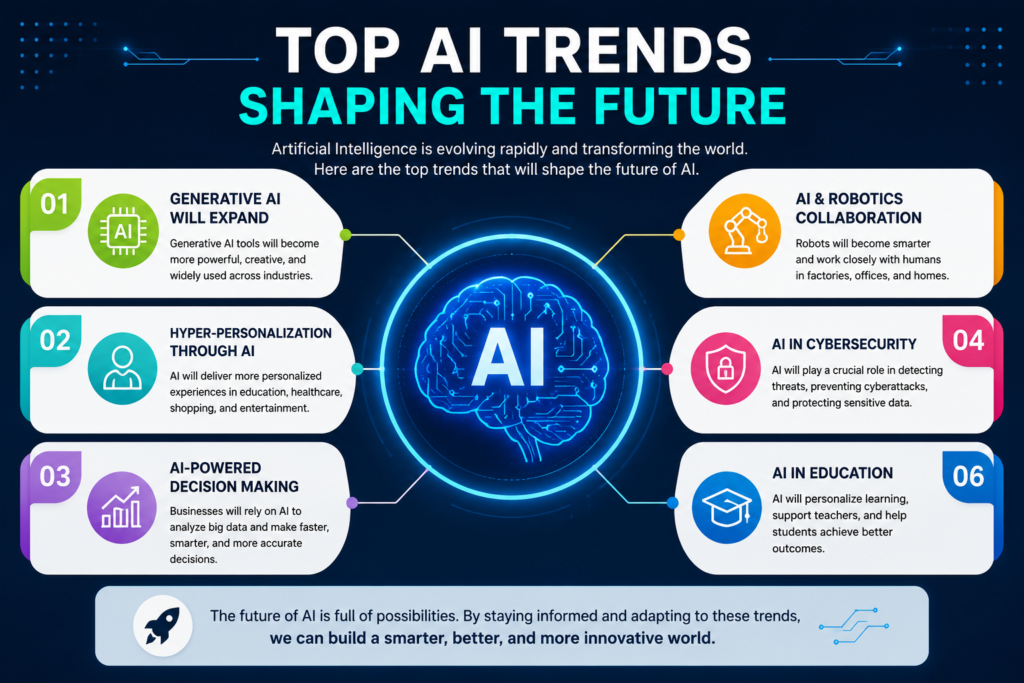
1. Generative AI Will Continue to Grow
Generative AI has become one of the biggest breakthroughs in recent years. Tools like ChatGPT, Gemini, Claude, and AI image generators can create text, images, videos, code, and even music within seconds.
In the coming years, businesses are expected to rely even more on Generative AI for:
- Content creation
- Customer support
- Software development
- Marketing campaigns
- Product design
- Business automation
As these tools become more advanced, they will improve productivity while reducing repetitive work.
2. AI Will Become More Personalised
Another major trend in the Future of Artificial Intelligence is personalisation.
Instead of providing the same experience to every user, AI systems will better understand individual preferences, habits, and behaviour.
Examples include:
- Personal AI assistants
- Personalised education platforms
- Smarter healthcare recommendations
- AI financial advisors
- Intelligent shopping experiences
These systems will continuously learn from user interactions to deliver more accurate and relevant recommendations.
3. Artificial Intelligence Will Improve Healthcare
Healthcare is expected to experience some of the biggest improvements through AI.
Future AI technologies may help doctors:
- Detect diseases earlier
- Analyse medical scans more accurately
- Develop new medicines faster
- Personalise treatment plans
- Monitor patients remotely
Instead of replacing healthcare professionals, Artificial Intelligence will likely serve as an intelligent assistant that improves diagnosis and patient care while reducing workload.
To explore how Artificial Intelligence is evolving across industries, visit IBM’s Artificial Intelligence Guide.
Artificial Intelligence in Business: The Future of Work
One of the biggest reasons experts are excited about the Future of Artificial Intelligence is its ability to transform businesses across every industry. Companies are no longer using AI only for simple automation. Instead, they are integrating Artificial Intelligence into decision-making, customer service, marketing, product development, cybersecurity, and financial management.
Modern businesses generate massive amounts of data every day. Analysing this information manually takes time and often leads to missed opportunities. Artificial Intelligence solves this problem by processing huge datasets within seconds and providing insights that help organisations make faster and more accurate decisions.
For example, AI-powered customer support chatbots can answer thousands of customer queries simultaneously without long waiting times. Marketing teams use AI to understand customer behaviour and create personalised advertising campaigns. Retail companies rely on AI to predict product demand, manage inventory, and improve customer recommendations.
The Future of Artificial Intelligence will also change how employees work. Instead of replacing every worker, AI is expected to automate repetitive and time-consuming tasks while allowing people to focus on creative thinking, strategy, communication, and problem-solving. This collaboration between humans and AI will increase productivity rather than eliminate the need for skilled professionals.
Small businesses will benefit as well. Affordable AI tools are making advanced technology accessible even to startups and freelancers. From AI writing assistants to accounting software and customer relationship management systems, Artificial Intelligence is becoming an essential business partner for organisations of every size.
As AI technology continues to improve, businesses that adopt responsible AI solutions will likely gain a competitive advantage by improving efficiency, reducing costs, and delivering better customer experiences.
Artificial Intelligence in Education and Everyday Life
The Future of Artificial Intelligence is not limited to businesses and large organisations. AI is already changing how students learn, teachers teach, and people complete everyday tasks.
In education, Artificial Intelligence enables personalised learning experiences. Instead of every student following the same pace, AI-powered learning platforms can identify strengths and weaknesses, recommend customised study materials, and provide instant feedback. This helps students learn more efficiently while allowing teachers to focus on mentoring and critical thinking rather than routine administrative work.
Language learning applications, virtual tutors, AI writing assistants, and intelligent research tools are becoming increasingly common in classrooms and online education. These technologies make learning more interactive and accessible for students around the world.
Beyond education, the Future of Artificial Intelligence will continue shaping daily life in countless ways.
Smart home devices can automatically adjust lighting, temperature, and security based on user preferences. Navigation apps use AI to recommend the fastest travel routes by analysing live traffic conditions. Streaming platforms suggest movies and music based on viewing history, while online shopping websites recommend products that match individual interests.
Healthcare wearables powered by AI can monitor heart rate, sleep quality, and physical activity while providing health recommendations. Banking applications use Artificial Intelligence to detect unusual transactions and protect customers from fraud. Even smartphones now rely on AI for voice recognition, photography enhancements, spam detection, and language translation.
As Artificial Intelligence becomes even more advanced, these everyday experiences will become faster, smarter, and more personalised. The goal is not simply to automate tasks but to improve convenience, efficiency, and the overall quality of life.
However, alongside these benefits, society must continue addressing challenges such as data privacy, ethical AI development, and digital security to ensure the Future of Artificial Intelligence remains beneficial for everyone.
Artificial Intelligence and Future Careers
One of the biggest questions surrounding the Future of Artificial Intelligence is how it will affect jobs and careers. Many people worry that AI will replace human workers, while others believe it will create entirely new employment opportunities. The reality is likely to be somewhere in between.
Artificial Intelligence is expected to automate repetitive, predictable, and data-driven tasks. Jobs that involve routine administrative work, basic data entry, and repetitive manufacturing processes are already being transformed through automation. However, history shows that every major technological revolution has also created new industries and career paths.
The Future of Artificial Intelligence will increase demand for professionals with skills in AI development, data science, cybersecurity, machine learning, robotics, cloud computing, and AI ethics. At the same time, human skills such as creativity, leadership, emotional intelligence, communication, and critical thinking will become even more valuable because these qualities cannot easily be replaced by machines.
Students entering today’s workforce should view AI as a tool rather than a threat. Learning how to work alongside Artificial Intelligence will become an important skill across almost every profession. Teachers, doctors, engineers, marketers, accountants, designers, and business owners will increasingly use AI-powered tools to improve their productivity instead of performing every task manually.
Companies are also investing in employee training programs that help workers understand AI technologies and adapt to changing workplace requirements. Professionals who continuously learn new digital skills will have better career opportunities in the AI-driven economy.
Instead of asking whether AI will take jobs, a better question is how people can prepare for the Future of Artificial Intelligence by developing skills that complement intelligent technologies.
Challenges That Could Shape the Future of Artificial Intelligence
Although the Future of Artificial Intelligence is full of exciting opportunities, several important challenges must still be addressed before AI reaches its full potential.
Privacy and Data Security
Artificial Intelligence depends heavily on data. Protecting personal information while allowing AI systems to learn effectively remains one of the biggest challenges facing developers and governments.
Ethical AI Development
AI systems must be designed to make fair and unbiased decisions. Researchers continue working to reduce algorithmic bias and improve transparency so users can understand how AI reaches its conclusions.
Government Regulations
As Artificial Intelligence becomes more powerful, countries are introducing laws and policies that encourage responsible AI development while protecting citizens’ rights. Finding the right balance between innovation and regulation will play a major role in the future of AI.
Cybersecurity Risks
AI can strengthen cybersecurity by identifying threats quickly, but criminals may also use AI to create more sophisticated cyberattacks. Continuous investment in AI security will be essential to protect businesses and individuals.
Human Oversight
No matter how advanced AI becomes, human supervision will remain important. Experts believe the Future of Artificial Intelligence should focus on collaboration between humans and intelligent machines rather than giving AI complete control over critical decisions.
These challenges highlight why responsible innovation is just as important as technological advancement. Successfully addressing them will help ensure Artificial Intelligence remains safe, trustworthy, and beneficial for society.
Frequently Asked Questions (FAQs)
Will Artificial Intelligence Replace Human Jobs?
Artificial Intelligence will automate some repetitive and predictable tasks, but it is unlikely to replace humans entirely. Instead, the Future of Artificial Intelligence is expected to transform the workplace by creating new career opportunities while changing the way existing jobs are performed. Professionals who learn AI-related skills and adapt to new technologies will remain highly valuable.
Which Industries Will Benefit Most from Artificial Intelligence?
Almost every industry will benefit from AI, but some sectors are expected to experience the biggest transformation, including:
- Healthcare
- Education
- Banking and Finance
- Manufacturing
- Retail and E-commerce
- Transportation
- Agriculture
- Cybersecurity
- Marketing
- Customer Service
As the Future of Artificial Intelligence continues to evolve, these industries will use AI to improve efficiency, reduce costs, and deliver better services.
Is Artificial Intelligence Safe for the Future?
Yes, provided it is developed responsibly.
The Future of Artificial Intelligence depends on ethical development, strong cybersecurity, transparent algorithms, and appropriate government regulations. Technology companies and researchers are already investing heavily in AI safety to ensure these systems remain reliable and beneficial for society.
Will Everyone Need AI Skills in the Future?
Basic AI knowledge is becoming increasingly valuable regardless of profession.
Students, teachers, business owners, healthcare professionals, engineers, marketers, and many other professionals will benefit from understanding how Artificial Intelligence works and how AI tools can improve productivity.
Learning AI today can provide a significant advantage in tomorrow’s job market.
What Is the Biggest Opportunity in the Future of Artificial Intelligence?
The biggest opportunity is using AI to solve real-world problems.
Artificial Intelligence has the potential to improve healthcare, accelerate scientific research, reduce business costs, personalise education, strengthen cybersecurity, and help address global challenges such as climate change and resource management.
The Future of Artificial Intelligence is not only about smarter machines—it is about improving people’s lives.
Final Thoughts
The Future of Artificial Intelligence is one of the most exciting technological developments of the 21st century. Every year, AI becomes more capable, more accessible, and more deeply integrated into our personal and professional lives.
Before exploring the Future of Artificial Intelligence, it’s also important to understand Is Artificial Intelligence Safe? and how responsible AI development is shaping tomorrow’s technology.
From healthcare and education to business, transportation, cybersecurity, and scientific research, Artificial Intelligence is already changing how the world operates. Over the coming years, AI will continue helping organisations make better decisions, automate routine tasks, improve customer experiences, and solve increasingly complex problems.
However, the future of AI is not defined only by technological progress. It also depends on responsible innovation, ethical development, strong privacy protection, and meaningful human oversight. Building trustworthy AI systems will require collaboration between governments, researchers, businesses, and society as a whole.
For individuals, understanding the Future of Artificial Intelligence means preparing for a world where AI becomes a valuable everyday tool. Rather than fearing these changes, learning how to work alongside Artificial Intelligence will create new opportunities for personal growth, career development, and innovation.
Artificial Intelligence is not simply the future of technology—it is becoming an essential part of the future of humanity itself. Those who embrace continuous learning and adapt to AI-driven innovation will be best positioned to succeed in the years ahead.